Alert
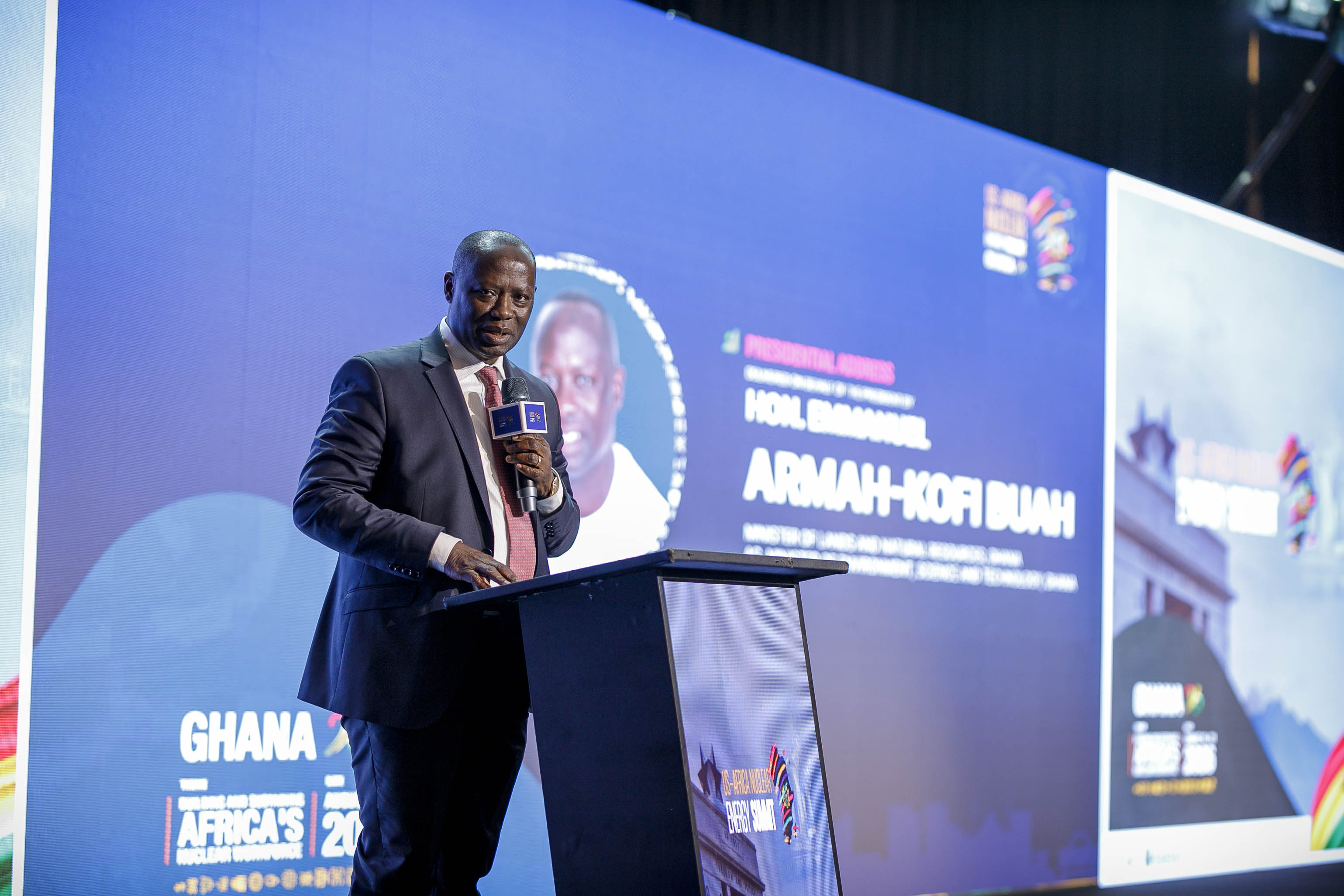
Address by Hon. Emmanuel Armah-Kofi Buah U.S.-Africa Nuclear Energy Summit, Accra
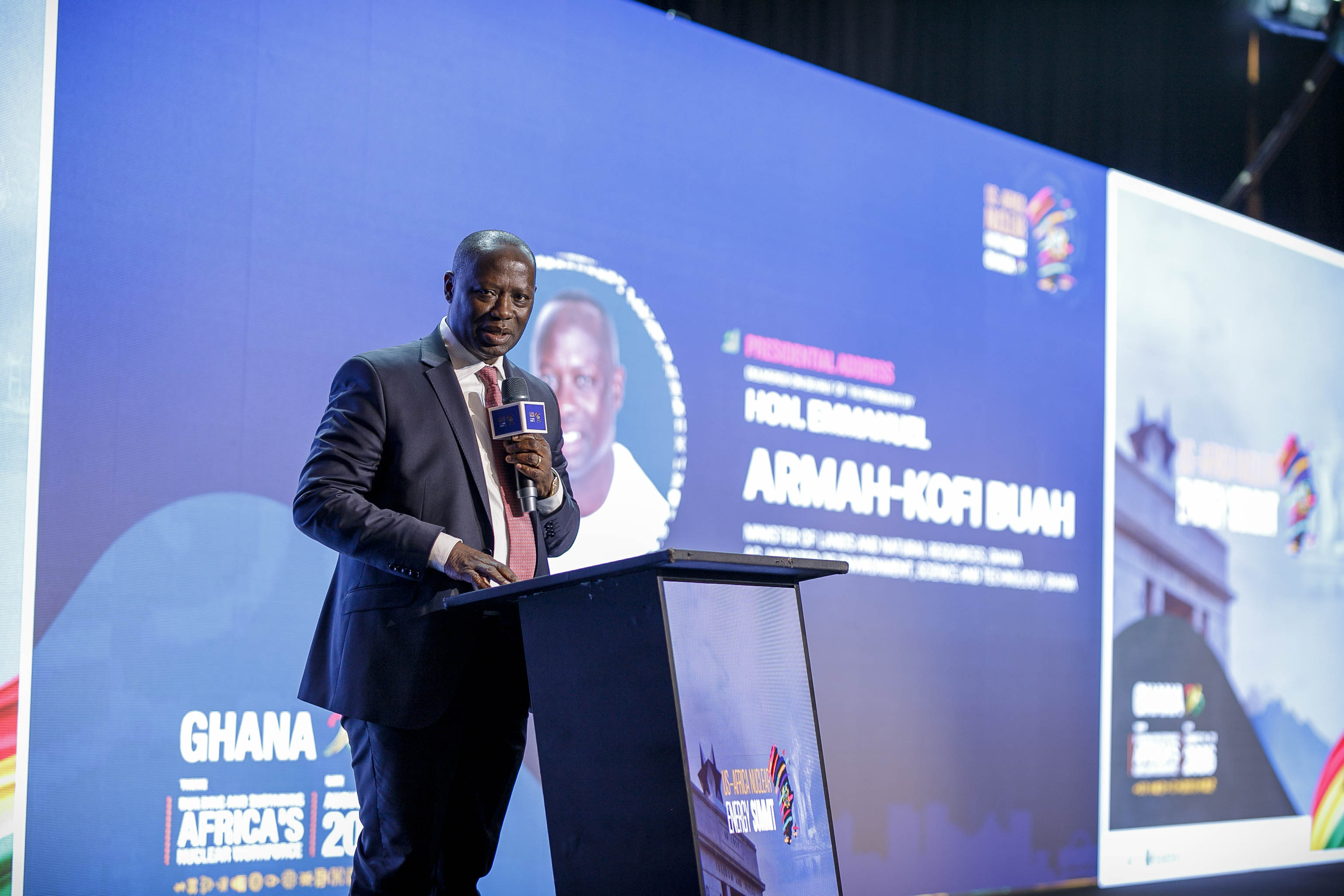
Thank you very much. Thank you.
Honourable Ministers, senior government officials from Ghana and across Africa, Your Excellencies, members of the diplomatic corps, I note the Minister of Energy in Djibouti, and I note our Energy Minister.
And when you see Ghana's Energy Minister and his predecessor, the former Energy Minister, in the same room on one topic, then it is a very serious topic.
Captains of industry, members of academia and the scientific community, representatives of civil society.
His Excellency President John Dramani Mahama, who would have very much wanted to be here but for a very important national assignment as well, extends his akwaaba to all of you to Ghana.
It is our honour and privilege to welcome you today to Accra for the U.S.-Africa Nuclear Energy Summit under the important theme, “Building and Sustaining Africa's Nuclear Workforce.”
Ghana is pleased to host this gathering at an important moment for our continent.
Africa's demand for energy is growing. Our population is young. Our cities are expanding. Our industries require reliable power. And that has all been stated this morning.
New technologies are also changing the global economy.
And the question before us is no longer whether Africa will participate in this changing world.
The question is whether we will participate principally as consumers of technologies developed elsewhere, or whether we will build the knowledge, institutions and people required to become producers, innovators and owners in our own right.
For Ghana, that question is not new.
As has previously been stated, more than six decades ago, our founding President, Dr. Kwame Nkrumah, understood that our political independence would remain incomplete without scientific and technological capacity.
His ambition went far beyond the construction of a reactor.
Nkrumah understood that the true strength of a nation would ultimately rest in the knowledge and capabilities of its people: the scientists, the engineers, the technicians, the researchers.
That ambition, or that vision, was interrupted, but did not die.
In 2012, during his first term in office, His Excellency President John Mahama directed the reactivation of Ghana's nuclear power programme, supported by the institutional reforms that eventually led to the passage of the Nuclear Regulatory Authority Act, 2015, Act 895.
Successive governments have contributed to this national journey.
And today, Ghana has moved beyond aspiration.
We are preparing.
And so when we state that Ghana is ready, I'm here to emphasise: we are truly ready. We are ready.
I think you can clap.
Ghana has formally entered Phase Two of the International Atomic Energy Agency's Milestones Approach for developing nuclear power infrastructure.
Detailed site studies, institutional strengthening, stakeholder engagement and engagement with technology vendors are all advanced.
Distinguished ladies and gentlemen, the theme of this summit asks us to consider something even more fundamental:
Who will build Africa's nuclear future?
A nuclear programme is not simply a reactor.
It is the people.
The International Atomic Energy Agency recognises human resource development as one of the 19 infrastructure issues essential to a successful nuclear power programme.
That tells us something very important.
Human capacity in itself is infrastructure.
We therefore cannot build the physical infrastructure today and hope to find the people tomorrow.
We must build both now.
And Africa has an extraordinary advantage, as has been stated earlier.
By 2050, Africa will remain home to one of the youngest populations in the world.
Within that generation are the scientists, engineers, technicians, regulators, researchers and entrepreneurs who can build and sustain Africa's nuclear future.
Our responsibility is to make sure that their talent has somewhere to go.
We must strengthen science, technology, engineering and mathematics education.
We must strengthen our universities and research institutions.
And we must invest in postgraduate studies.
It also requires highly trained technicians, electricians, welders, instrumentation specialists, construction professionals, safety specialists, cybersecurity professionals and many related disciplines.
A skilled technician must therefore be recognised as an essential participant in Africa's technological future.
But there is another African talent pool that we must deliberately bring into this conversation.
And that's our diaspora.
Across the United States, Europe and other parts of the world are Ghanaian and African scientists, engineers, researchers, academics, technology professionals and industry leaders working at some of the most advanced institutions in the world.
They are not lost to Africa. They are part of Africa's human capital.
The question is whether we have created the structures through which their knowledge can flow back into our universities, institutions, industries and our young people.
Young scientists should have access to laboratories and centres of excellence across the world while building careers and institutions here at home.
We must therefore move from simply discussing brain drain to deliberately building the circulation of knowledge, expertise and opportunities between Africa and its diaspora.
Our industries must create African jobs.
Our universities must produce African expertise.
And our research institutions must help solve African problems.
And our international partnerships must leave behind strong African institutions.
This is not an argument against international partnerships.
It is precisely why partnerships like this, the one we are celebrating today, matter.
The partnership between the United States and Africa should increasingly be measured not only by what is built in Africa, but also by what Africa becomes capable of building for itself.
Technology transfer must be accompanied by knowledge transfer.
And investments must help create skills.
And infrastructure must create careers.
And cooperation must strengthen institutions.
This is how partnerships become sustainable.
And I think that our relationship, our partnership with the U.S. nuclear energy sector must be celebrated.
And I think we can clap for that.
This summit therefore presents us with an opportunity to think beyond individual national programmes.
Africa should begin a connected nuclear talent ecosystem.
Our universities should collaborate.
Our regulators should share experiences.
Our research institutions should work across our borders.
And together, we can create a pool of knowledge far greater than any one country could develop independently.
I therefore invite the summit to consider how we can move towards an African Nuclear Talent and Diaspora Network, bringing together governments, universities, technical institutions, regulators, industry, development partners and African professionals around the world.
Let Accra, and let this summit, be remembered not simply as another place where we discussed Africa's nuclear future.
Let it be remembered as a place where we began connecting the people who will build it.
None of these ambitions can be separated from safety, ladies and gentlemen.
In the nuclear sector, safety cannot be a changing priority.
It must be an uncompromising condition governing every decision, every institution and every person involved.
And our people must know that technological ambition will never be pursued at the expense of their safety or well-being.
Africa is entering an important period.
Our energy needs are enormous, as has been variously stated.
But so too is our potential.
The decisions we make today will determine whether the next generation inherits another industry in which Africa participates at the margins, or an industry in which Africans possess the knowledge, skills and institutions to lead.
More than 60 years ago, Dr. Kwame Nkrumah, our first President, understood that scientific capability was inseparable from genuine independence.
Today, President Mahama's Reset Agenda calls upon us once again to transform Ghana through our own productive capacity, our natural resources and, above all, our people.
Our generation now carries the responsibility forward.
And perhaps the greatest investment we can make will never appear on the blueprint of a nuclear facility.
It is the investment we make in the mind of a young African.
Because somewhere on this continent is a child who may one day design a reactor, regulate a nuclear facility, make a scientific breakthrough, or lead an institution we have not yet imagined.
This child should not have to ask whether Africa has a place for her brilliance.
We must begin that process at this summit.
We must build that place.
Let us build the institutions.
Let us build the partnerships.
And let us build the knowledge.
And above all, let us build the people.
If we do that, we will have achieved something greater than building Africa's nuclear power capacity.
We will have strengthened Africa's capacity to shape its own future.
This is the future, and this is why we have gathered here.
I thank you.
May God bless Ghana, and may God bless the African continent and our partnership.
Thank you very much.
TRANSCRIPT
Address by Hon. Emmanuel Armah-Kofi Buah
U.S.-Africa Nuclear Energy Summit, Accra
Thank you very much. Thank you.
Honourable Ministers, senior government officials from Ghana and across Africa, Your Excellencies, members of the diplomatic corps, I note the Minister of Energy in Djibouti, and I note our Energy Minister.
And when you see Ghana's Energy Minister and his predecessor, the former Energy Minister, in the same room on one topic, then it is a very serious topic.
Captains of industry, members of academia and the scientific community, representatives of civil society.
His Excellency President John Dramani Mahama, who would have very much wanted to be here but for a very important national assignment as well, extends his akwaaba to all of you to Ghana.
It is our honour and privilege to welcome you today to Accra for the U.S.-Africa Nuclear Energy Summit under the important theme, “Building and Sustaining Africa's Nuclear Workforce.”
Ghana is pleased to host this gathering at an important moment for our continent.
Africa's demand for energy is growing. Our population is young. Our cities are expanding. Our industries require reliable power. And that has all been stated this morning.
New technologies are also changing the global economy.
And the question before us is no longer whether Africa will participate in this changing world.
The question is whether we will participate principally as consumers of technologies developed elsewhere, or whether we will build the knowledge, institutions and people required to become producers, innovators and owners in our own right.
For Ghana, that question is not new.
As has previously been stated, more than six decades ago, our founding President, Dr. Kwame Nkrumah, understood that our political independence would remain incomplete without scientific and technological capacity.
His ambition went far beyond the construction of a reactor.
Nkrumah understood that the true strength of a nation would ultimately rest in the knowledge and capabilities of its people: the scientists, the engineers, the technicians, the researchers.
That ambition, or that vision, was interrupted, but did not die.
In 2012, during his first term in office, His Excellency President John Mahama directed the reactivation of Ghana's nuclear power programme, supported by the institutional reforms that eventually led to the passage of the Nuclear Regulatory Authority Act, 2015, Act 895.
Successive governments have contributed to this national journey.
And today, Ghana has moved beyond aspiration.
We are preparing.
And so when we state that Ghana is ready, I'm here to emphasise: we are truly ready. We are ready.
I think you can clap.
Ghana has formally entered Phase Two of the International Atomic Energy Agency's Milestones Approach for developing nuclear power infrastructure.
Detailed site studies, institutional strengthening, stakeholder engagement and engagement with technology vendors are all advanced.
Distinguished ladies and gentlemen, the theme of this summit asks us to consider something even more fundamental:
Who will build Africa's nuclear future?
A nuclear programme is not simply a reactor.
It is the people.
The International Atomic Energy Agency recognises human resource development as one of the 19 infrastructure issues essential to a successful nuclear power programme.
That tells us something very important.
Human capacity in itself is infrastructure.
We therefore cannot build the physical infrastructure today and hope to find the people tomorrow.
We must build both now.
And Africa has an extraordinary advantage, as has been stated earlier.
By 2050, Africa will remain home to one of the youngest populations in the world.
Within that generation are the scientists, engineers, technicians, regulators, researchers and entrepreneurs who can build and sustain Africa's nuclear future.
Our responsibility is to make sure that their talent has somewhere to go.
We must strengthen science, technology, engineering and mathematics education.
We must strengthen our universities and research institutions.
And we must invest in postgraduate studies.
It also requires highly trained technicians, electricians, welders, instrumentation specialists, construction professionals, safety specialists, cybersecurity professionals and many related disciplines.
A skilled technician must therefore be recognised as an essential participant in Africa's technological future.
But there is another African talent pool that we must deliberately bring into this conversation.
And that's our diaspora.
Across the United States, Europe and other parts of the world are Ghanaian and African scientists, engineers, researchers, academics, technology professionals and industry leaders working at some of the most advanced institutions in the world.
They are not lost to Africa. They are part of Africa's human capital.
The question is whether we have created the structures through which their knowledge can flow back into our universities, institutions, industries and our young people.
Young scientists should have access to laboratories and centres of excellence across the world while building careers and institutions here at home.
We must therefore move from simply discussing brain drain to deliberately building the circulation of knowledge, expertise and opportunities between Africa and its diaspora.
Our industries must create African jobs.
Our universities must produce African expertise.
And our research institutions must help solve African problems.
And our international partnerships must leave behind strong African institutions.
This is not an argument against international partnerships.
It is precisely why partnerships like this, the one we are celebrating today, matter.
The partnership between the United States and Africa should increasingly be measured not only by what is built in Africa, but also by what Africa becomes capable of building for itself.
Technology transfer must be accompanied by knowledge transfer.
And investments must help create skills.
And infrastructure must create careers.
And cooperation must strengthen institutions.
This is how partnerships become sustainable.
And I think that our relationship, our partnership with the U.S. nuclear energy sector must be celebrated.
And I think we can clap for that.
This summit therefore presents us with an opportunity to think beyond individual national programmes.
Africa should begin a connected nuclear talent ecosystem.
Our universities should collaborate.
Our regulators should share experiences.
Our research institutions should work across our borders.
And together, we can create a pool of knowledge far greater than any one country could develop independently.
I therefore invite the summit to consider how we can move towards an African Nuclear Talent and Diaspora Network, bringing together governments, universities, technical institutions, regulators, industry, development partners and African professionals around the world.
Let Accra, and let this summit, be remembered not simply as another place where we discussed Africa's nuclear future.
Let it be remembered as a place where we began connecting the people who will build it.
None of these ambitions can be separated from safety, ladies and gentlemen.
In the nuclear sector, safety cannot be a changing priority.
It must be an uncompromising condition governing every decision, every institution and every person involved.
And our people must know that technological ambition will never be pursued at the expense of their safety or well-being.
Africa is entering an important period.
Our energy needs are enormous, as has been variously stated.
But so too is our potential.
The decisions we make today will determine whether the next generation inherits another industry in which Africa participates at the margins, or an industry in which Africans possess the knowledge, skills and institutions to lead.
More than 60 years ago, Dr. Kwame Nkrumah, our first President, understood that scientific capability was inseparable from genuine independence.
Today, President Mahama's Reset Agenda calls upon us once again to transform Ghana through our own productive capacity, our natural resources and, above all, our people.
Our generation now carries the responsibility forward.
And perhaps the greatest investment we can make will never appear on the blueprint of a nuclear facility.
It is the investment we make in the mind of a young African.
Because somewhere on this continent is a child who may one day design a reactor, regulate a nuclear facility, make a scientific breakthrough, or lead an institution we have not yet imagined.
This child should not have to ask whether Africa has a place for her brilliance.
We must begin that process at this summit.
We must build that place.
Let us build the institutions.
Let us build the partnerships.
And let us build the knowledge.
And above all, let us build the people.
If we do that, we will have achieved something greater than building Africa's nuclear power capacity.
We will have strengthened Africa's capacity to shape its own future.
This is the future, and this is why we have gathered here.
I thank you.
May God bless Ghana, and may God bless the African continent and our partnership.
Thank you very much.
Media